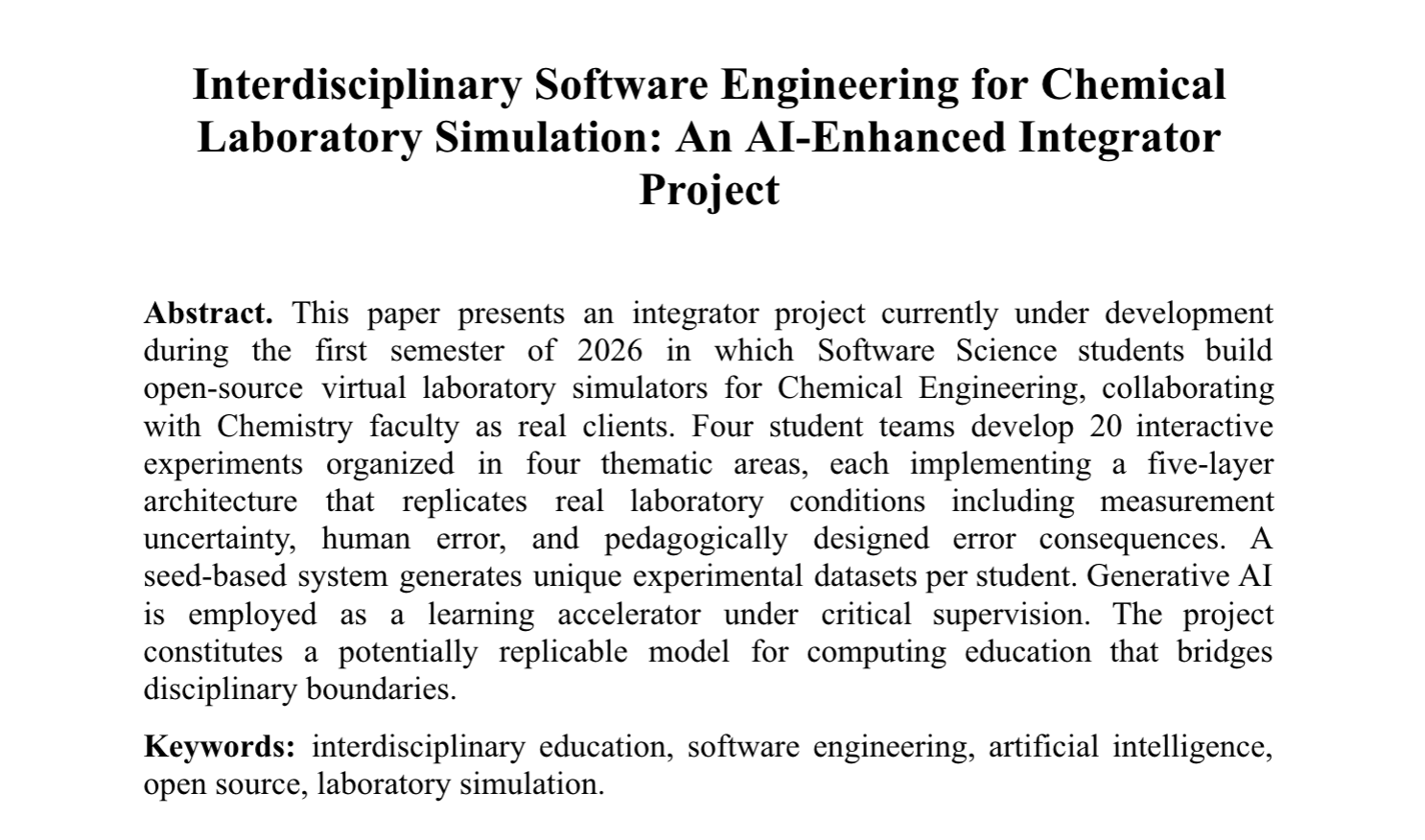
This month, Pablo Deymonnaz, director of our center, attended the 55th Argentine Conference on Computer Science (JAIIO) to present the short paper "Interdisciplinary Software Engineering for Chemical Laboratory Simulation: An AI-Enhanced Integrator Project". It was a source of pride to share part of our work at the conference, and a very enriching experience to engage in dialogue with the community from all over the country.
An ongoing experience at the Faculty of Engineering of UBA
The paper describes an integrator project currently under way at the Faculty of Engineering of the University of Buenos Aires, within the Programming Workshop course of the Computer Engineering degree. The proposal starts from a simple but unusual idea for this kind of course: instead of assigning a generic application, students are invited to solve a real problem, with a real client.
Four teams of four students are each responsible for one thematic area within a common goal: developing open-source virtual laboratory simulators for Chemical Engineering. In total, the suite comprises 20 interactive experiments distributed across kinetics and catalysis, electrochemistry, thermodynamics, and spectroscopy and transport, ranging from the classic iodine clock to cyclic voltammetry or diffusion in gel. Chemical Engineering faculty from the same school act as those clients, periodically validating the models the students build.
The role of artificial intelligence
Generative AI runs through four phases of the process: as support in the initial research of the chemical domain (always cross-checked against the literature), in the architecture design, in the implementation — with mandatory pull request review of all AI-generated code — and in testing, validating results against known solutions. The underlying idea, as the paper argues, is not to ban these tools but to build literacy in their critical use. AI accelerates learning, but it does not replace dialogue with domain specialists or human code review.
What comes next
The next steps include completing the 20 experiments, testing the suite with Chemical Engineering students — the end users of the simulators — and designing a study to measure its real impact on learning. Ultimately, this is a model that aims to be replicable: the combination of a real client, free software, supervised AI and disciplinary depth can be transferred to other courses looking to build similar bridges with other degree programs.
Sharing this work at the 55th JAIIO was an opportunity to open a discussion, with the computer science community from all over the country, about a way of teaching that crosses disciplinary boundaries and combines technical rigor with artificial intelligence used critically and responsibly.